New Orleans has always run on songs, and on the people who write them and sing them themselves. Dave Bartholomew wrote the songs, led the band, and played trumpet on the records. Fats Domino wrote the melodies he sang. That is what this guide is about: writers who sing their own material — not singers who only interpret other people's songs, and not writers who only write for others. Bobby Charles, who wrote "See You Later, Alligator" and "Walking to New Orleans," is known as a songwriter, not a singer — so he is not an entry here.
The point of this guide is simple: hear the music, and if it grabs you, buy it. Every entry below leads with Listen & Buy links — the artist's nolamusic.net page, where the Listen bar carries Spotify and Apple Music, plus Louisiana Music Factory, Euclid Records, and Amazon for buying. The prose is the invitation; the links are the purpose.
What follows is an introduction, not an encyclopedia: the sound itself, the line of writers who made it, and the living musicians still carrying it. Every artist below has a page on nolamusic.net, linked at the top of each entry. Four of the writers here — Fats Domino, Professor Longhair, Allen Toussaint, and Dr. John — also appear in the piano guide. Their keyboards are that guide's subject; here, it is the songs.
What it sounds like
Six things to listen for. Once you hear them, you'll recognize the style anywhere.
The melody you can hum. Fats Domino and Dave Bartholomew wrote songs built on melodies that stick after one hearing — simple, rolling, and sung the way people talk. "Blueberry Hill" and "Ain't That a Shame" are not clever songs. They are inevitable ones, and that is harder. Hear it in "I'm Walkin'," where the melody does the walking.
The story in plain language. Fats Domino never dressed a song up, and he never needed to. The best New Orleans songs say the thing straight, in the words the street uses. Hear it in "Ain't That a Shame" — three words, and you know exactly what happened.
The groove as composition. Allen Toussaint's songs are inseparable from their rhythm. "Working in the Coal Mine" is a pick-and-shovel groove before it is a lyric, and "Southern Nights" drifts the way a Louisiana evening does. The arrangement is part of the writing. Hear it in "Ride Your Pony," where the band is the hook.
The street song. Professor Longhair's songs came from the parade and the Mardi Gras Indian tradition — "Go to the Mardi Gras" and "Big Chief" are street music first, records second. They belong to the city as much as to the man who wrote them, and the city still sings them every Carnival. Hear it in "Tipitina," a song whose words nobody has ever fully explained, and which nobody needs explained.
The personal record. Susan Cowsill's Lighthouse and Dayna Kurtz's Postcards from Downtown are records written from a life lived — loss, home, and starting over, in songs that name names and places. The New Orleans singer/songwriter tradition is not only the 1950s hit factory; it is also the confessional album, made one song at a time. Hear it in Cowsill's "River of Love," written by her late brother Barry.
The standard that outlives its writer. Earl King's "Come On" and "Trick Bag" and Toussaint's "Fortune Teller" are songs other artists keep carrying — Jimi Hendrix, Stevie Ray Vaughan, the Rolling Stones, the Meters, Robert Palmer. A New Orleans song does not end with its writer. It gets picked up, played again, and handed on. Hear it in the Meters' "Trick Bag," which is Earl King's song wearing a funk suit.
The founders
Dave Bartholomew (1918–2019)

Dave Bartholomew was born December 24, 1918, in Edgard, Louisiana, and died June 23, 2019, in New Orleans, aged 100. He was a trumpeter, bandleader, arranger, producer, and songwriter, and as Imperial Records' house bandleader in the 1950s he was the man behind the sound of New Orleans rock and roll. He wrote the songs, produced the sessions, led the band, and played trumpet on the records — the whole job, in one person.
With Fats Domino he wrote "Ain't That a Shame" (1955), "Blue Monday" (1956), and "I'm Walkin'" (1957), the backbone of Domino's run of hits. He wrote "I Hear You Knocking" and "One Night" for Smiley Lewis, in 1955 and 1956; "One Night" became a hit for Elvis Presley in 1958, and "I Hear You Knocking" a hit for Dave Edmunds in 1970. He produced Lloyd Price's "Lawdy Miss Clawdy" (1952), one of the first New Orleans R&B records to cross over nationally. He entered the Rock and Roll Hall of Fame in 1991 and the Songwriters Hall of Fame in 1998.
Start with: "Ain't That a Shame" — Fats Domino (1955); "I Hear You Knocking" — Smiley Lewis (1955); "One Night" — Smiley Lewis (1956); "Blue Monday" — Fats Domino (1956).
Watch: Fats Domino, "Ain't That a Shame," live in 1962, with Bartholomew on trumpet in the band — https://www.youtube.com/watch?v=xJ4nHjWIBV4 · "Ain't It a Shame," the 1955 master — https://www.youtube.com/watch?v=HnrH2V2JLPI
Fats Domino (1928–2017)
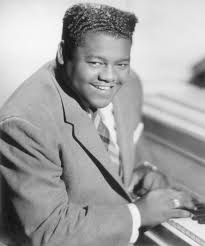
Antoine Dominique Domino Jr. was born February 26, 1928, in New Orleans, and died October 24, 2017. He was a singer, pianist, and songwriter, and one of the builders of rock and roll: thirty-five of his records reached the Billboard Top 40, a run no other New Orleans artist has matched. He wrote most of his hits with Dave Bartholomew, and sang them in a warm, unhurried baritone over his own rolling piano. His piano style is the piano guide's subject; here, it is the songs — melodies so plain and sturdy they sound as if they were always there.
"The Fat Man" (1949) is often named among the first rock and roll records. "Ain't That a Shame" (1955) was his first million-seller, reaching number one on the R&B chart and the Top 10 on the pop chart. "Blueberry Hill" (1956) reached number two pop and number one R&B. "I'm Walkin'," "Blue Monday," and "Walking to New Orleans" (1960, written by Bobby Charles) followed. He was in the inaugural class of the Rock and Roll Hall of Fame in 1986, received a Grammy Lifetime Achievement Award in 1987 and the National Medal of Arts in 1998. He stayed in New Orleans through Hurricane Katrina, was rescued from his Lower Ninth Ward home, and lost his piano and his possessions — and came back.
Start with: Rock and Rollin' with Fats Domino (1956); This Is Fats! (1957); The Fats Domino Jukebox: 20 Greatest Hits (2002 compilation).
Watch: "Blueberry Hill" on The Ed Sullivan Show (1956) — https://www.youtube.com/watch?v=t6H_sxI6jG8 · "Blueberry Hill" live on Austin City Limits — https://www.youtube.com/watch?v=ardeW1HPhH0
Professor Longhair (1918–1980)
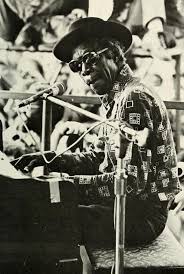
Henry Roeland Byrd, known as Professor Longhair — "Fess" — was born in December 1918 in Bogalusa, Louisiana, and died January 30, 1980, in New Orleans. He was a singer and pianist whose songs are part of the city's street life: "Tipitina" (1953), "Go to the Mardi Gras" (1959), and "Big Chief" (1964) are parade music and Mardi Gras Indian music first, records second. His piano playing is the piano guide's subject; here, it is the writing — songs built from the rhythm of the street, with words that sound like somebody talking.
His only national hit was "Bald Head" (1950), recorded under the name Roy Byrd and His Blues Jumpers. His recording career stalled in the 1960s, and he was rediscovered in the 1970s, playing the first New Orleans Jazz & Heritage Festival in 1970 and recording the albums that made his reputation: Rock 'n' Roll Gumbo (1977), Live on the Queen Mary (1978), and Crawfish Fiesta (1980). He entered the Rock and Roll Hall of Fame in 1992. The club Tipitina's, opened in 1977, took its name from his song — a rare case of a song naming a room that still books music every night.
Start with: New Orleans Piano (1972); Rock 'n' Roll Gumbo (1977); Live on the Queen Mary (1978); Crawfish Fiesta (1980).
Watch: "Tipitina" with the Meters — https://www.youtube.com/watch?v=UBSN7WOPkQ0 · "Tipitina" (official audio) — https://www.youtube.com/watch?v=jB79nV4RLVE
The craftsmen
Earl King (1934–2003)

Earl King was born February 7, 1934, in New Orleans, and died April 17, 2003. He was a guitarist, singer, and songwriter — a working R&B musician whose songs kept turning up on other people's records, which is the truest measure of a songwriter. He wrote "Those Lonely, Lonely Nights" (1955), first a hit for Johnny "Guitar" Watson. He wrote "Come On" (1960), covered by Jimi Hendrix and Stevie Ray Vaughan. He wrote "Trick Bag" (1962), covered by the Meters and Robert Palmer. He wrote "Big Chief" for Professor Longhair (1964).
He recorded for Imperial Records in the early 1960s, backed by players including James Booker, and in the 1980s and 1990s made a run of albums for Black Top Records — Glazed (1986), Sexual Telepathy (1990), and Hard River to Cross (1993) — that showed a writer still sharpening his songs late in life. His guitar playing was sly and economical, and his singing had a dry humor that the songs needed: "Trick Bag" is a joke with a groove under it, and the groove is the point.
Start with: Come On: The Complete Imperial Recordings (2003); Glazed (1986); Sexual Telepathy (1990); Hard River to Cross (1993).
Watch: "Trick Bag" live at the New Orleans Jazz & Heritage Festival, 1991 — https://www.youtube.com/watch?v=-MP_Q2dCFco · "Trick Bag," the Imperial original — https://www.youtube.com/watch?v=BJ7IkhdXb7U
Allen Toussaint (1938–2015)
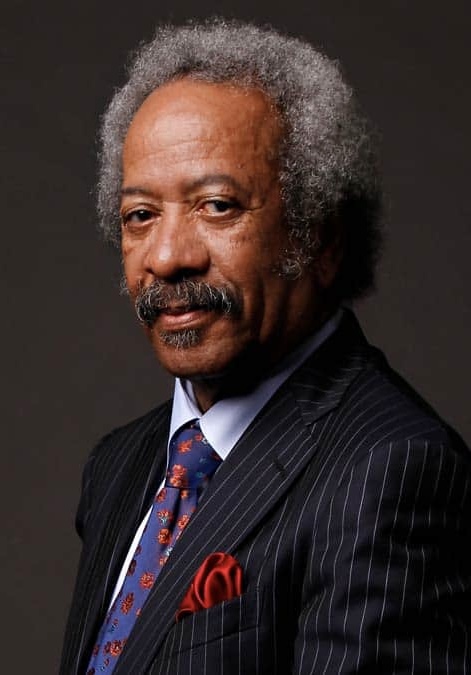
Allen Toussaint was born January 14, 1938, in New Orleans, and died November 10, 2015, in Madrid, while on tour. He was a pianist, songwriter, arranger, and producer — the most complete musician in this guide, and the one other New Orleans writers measured themselves against. He wrote the songs, arranged the horns, played piano on the sessions, and produced the records, most of them in his own Sea-Saint Studio. His piano playing is the piano guide's subject; here, it is the catalog.
He wrote "Mother-in-Law" (Ernie K-Doe, 1961), a number-one record. He wrote "Working in the Coal Mine" and "Ride Your Pony" for Lee Dorsey (1966 and 1965). He wrote "Fortune Teller" (Benny Spellman, 1962), covered by the Rolling Stones and the Who. He wrote "Java" (Al Hirt, 1964), a Grammy winner. He wrote "Southern Nights" (1975); Glen Campbell's version was number one on the pop, country, and adult-contemporary charts in 1977. He produced Labelle's "Lady Marmalade" (1974) and Dr. John's In the Right Place (1973). He entered the Rock and Roll Hall of Fame in 1998, the Songwriters Hall of Fame in 2011, and received the National Medal of Arts in 2013.
Start with: The Wild Sound of New Orleans (1958, as Al Tousan); Southern Nights (1975); The Bright Mississippi (2009); American Tunes (2016).
Watch: "Southern Nights" (official audio) — https://www.youtube.com/watch?v=A0neL1hdA6Q · "Southern Nights" live, 2011 — https://www.youtube.com/watch?v=4EihE9a_mEE
Dr. John (1941–2019)
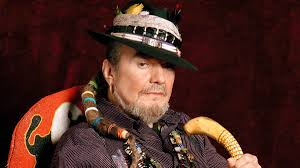
Malcolm John Rebennack Jr., known as Dr. John, was born November 20, 1941, in New Orleans, and died June 6, 2019. He was a singer, pianist, and songwriter, and a six-time Grammy winner. He began as a session guitarist and pianist in the 1950s, playing on other people's records, before inventing the Dr. John persona — the Night Tripper, part medicine-show doctor, part Mardi Gras Indian — and writing songs to fit it. His piano playing is the piano guide's subject; here, it is the songs, which mixed New Orleans R&B, voodoo imagery, and street talk into something no one else was writing.
Gris-Gris (1968) introduced him, with "I Walk on Gilded Splinters" its best-known song. "Right Place, Wrong Time" (1973), from the Allen Toussaint-produced In the Right Place, reached the Top 10 and became his signature song. "Such a Night" (1973) followed. Late in life he made two of his finest records: Goin' Back to New Orleans (1992) and Locked Down (2012), produced by Dan Auerbach, both Grammy winners. He played the songs until the end, in New Orleans and everywhere else.
Start with: Gris-Gris (1968); In the Right Place (1973); Goin' Back to New Orleans (1992); Locked Down (2012).
Watch: "Right Place, Wrong Time" live at Rockpalast, 1999 (official video) — https://www.youtube.com/watch?v=ueuxXZtTE4w · "Right Place, Wrong Time" live at the Newport Jazz Festival, 2006 — https://www.youtube.com/watch?v=oqk29Tupns0
The living voices
Jon Cleary (b. 1962)

Jon Cleary was born August 11, 1962, in Cranbrook, Kent, England, and came to New Orleans in his twenties and stayed. He is a pianist, guitarist, singer, and songwriter who learned the city's music the way the old players did — by sitting in, listening, and playing the rooms — and he writes songs that sound as if they grew out of the same ground. He leads the Absolute Monster Gentlemen, and has played with Bonnie Raitt and Taj Mahal.
His best-known song is "Frenchmen Street Blues," written for HBO's Treme, which has become a standard — other singers sing it now, which is what happens to a real song. His album Go Go Juice (2015) won the Grammy for Best Regional Roots Music Album. Dyna-Mite (2018) and So Swell (2023) followed, both full of songs that sound lived-in rather than written. He is the clearest proof in this guide that the tradition is still being written, not only remembered.
Start with: Jon Cleary and the Absolute Monster Gentlemen (2002); Go Go Juice (2015); Dyna-Mite (2018); So Swell (2023).
Watch: "Frenchmen Street Blues" (NORD LIVE, at Funk Headquarters) — https://www.youtube.com/watch?v=YUbRQoM_p-g · "Frenchmen Street Blues" (Paste Studios, 2018) — https://www.youtube.com/watch?v=ZP_VIamPcZ8
Paul Sanchez (b. 1959)
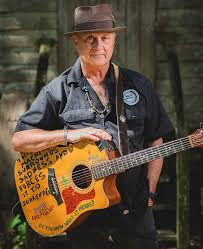
Paul Sanchez was born November 6, 1959, in New Orleans. He is a singer, guitarist, and songwriter who has spent his working life in the city's rooms, writing songs in a plainspoken voice that owes nothing to fashion. In 1990 he co-founded Cowboy Mouth with Fred LeBlanc, John Thomas Griffith, and Vance DeGeneres — a barroom rock band that became a New Orleans institution — and he has kept writing and singing his own songs alongside the band ever since.
His solo album Jet Black and Jealous (1992) is one of the finest singer/songwriter records the city has produced; the Eli Young Band covered the title song in 1998. He plays a Wednesday happy hour at Carrollton Station, where the songs get heard the way they were meant to be heard — close up, in a room. His newest record, The Best Bards Know (2025), shows a writer still adding to the catalog more than three decades on.
Start with: Jet Black and Jealous (1992); Cowboy Mouth, Are You with Me? (1996); The Best Bards Know (2025).
Watch: "Jet Black and Jealous" (from The Best Bards Know, 2025) — https://www.youtube.com/watch?v=K4V355jjhWs · "Used to Be Crazy" — https://www.youtube.com/watch?v=Hy9ByLLPugY
Susan Cowsill (b. 1959)

Susan Cowsill was born May 20, 1959, in Canton, Ohio. She is a singer, guitarist, and songwriter who joined her family band, the Cowsills, at seven years old in 1966, and was singing on hit records before she was a teenager: "The Rain, the Park & Other Things" (1967), "Indian Lake" (1968), and "Hair" (1969). She joined the Continental Drifters with Vicki Peterson, Peter Holsapple, and Carlo Nuccio, and made New Orleans her home.
Her solo albums are the work of a writer, not a former child star: Just Believe It (2005) and Lighthouse (2010), written after Hurricane Katrina and the deaths of her brothers Barry and Bill. "River of Love," on Lighthouse, is Barry's song, recorded by his sister. She also sings in the Psycho Sisters, her duo with Vicki Peterson. Lighthouse is the most personal record in this guide — a New Orleans album about loss and starting over, written by someone who lived both.
Start with: The Cowsills (1967); Just Believe It (2005); Lighthouse (2010).
Watch: "River of Love" — https://www.youtube.com/watch?v=xva13taqpJY · "Galveston" (from Lighthouse) — https://www.youtube.com/watch?v=lg1cAEsj2r0
Dayna Kurtz
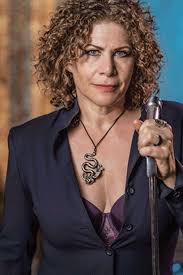
Dayna Kurtz is a New Jersey native who now lives in New Orleans, a singer, guitarist, and songwriter whose voice — deep, soulful, and unhurried — has drawn comparisons to Nina Simone and Marianne Faithfull. Her debut, Postcards from Downtown (2001), was a hit in the Netherlands, where "Love Gets in the Way" made her a star on Dutch television; a remixed 25th-anniversary edition is out for 2026. She has shared stages with Elvis Costello, B.B. King, and Norah Jones.
She writes big, mournful ballads and sings them with almost nothing behind her — often just her own acoustic guitar and Robert Maché's Telecaster. Beautiful Yesterday (2004) followed the debut, and her two Secret Canon volumes collect obscure standards and R&B gems from the 1940s, 1950s, and 1960s, sung as if they were her own songs. She is the quietest voice in this guide, and one of the most exacting: every note is placed, and nothing is wasted.
Start with: Postcards from Downtown (2001); Beautiful Yesterday (2004); Secret Canon (two volumes of standards and R&B gems).
Watch: "It's How You Hold Me" (VPRO, Netherlands) — https://www.youtube.com/watch?v=TNM9MdRxtTI · "Somebody Leave a Light On" — https://www.youtube.com/watch?v=gWAWQMiQEWA
Anders Osborne (b. 1966)
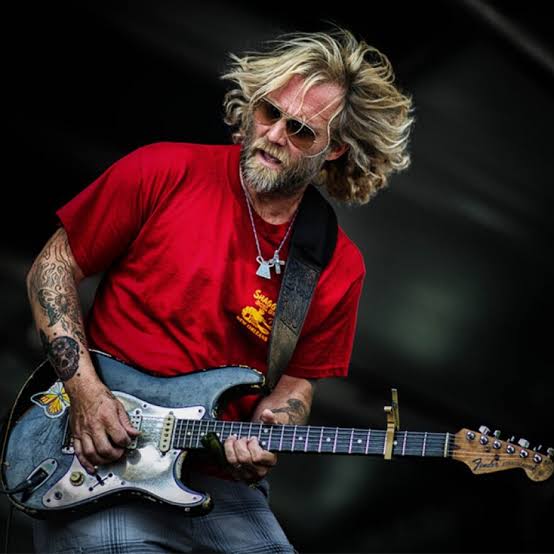
Anders Osborne was born May 4, 1966, in Uddevalla, Sweden, and came to New Orleans in 1990 and stayed. He is a guitarist, singer, and songwriter whose songs run on long, Neil Young-style guitar lines and lyrics written straight out of a journal — addiction, recovery, love, and the city itself. He is the rock end of this guide, and the proof that the New Orleans singer/songwriter tradition is not a museum piece.
His run of albums for Alligator Records — American Patchwork (2010), Black Eye Galaxy (2012), and Peace (2013) — made him a fixture of the scene and a regular at Jazz Fest. He has also written songs recorded by other artists — Tim McGraw, Keb' Mo', and Trombone Shorty among them — including songs that were Grammy-nominated. The title track of Peace is the clearest statement of what he writes about: looking for a day of peace, and playing his way toward it.
Start with: American Patchwork (2010); Black Eye Galaxy (2012); Peace (2013).
Watch: "Peace" — https://www.youtube.com/watch?v=uedu4ieDH64 · "Peace," solo performance — https://www.youtube.com/watch?v=lRjfRDwR1O8
Alex McMurray
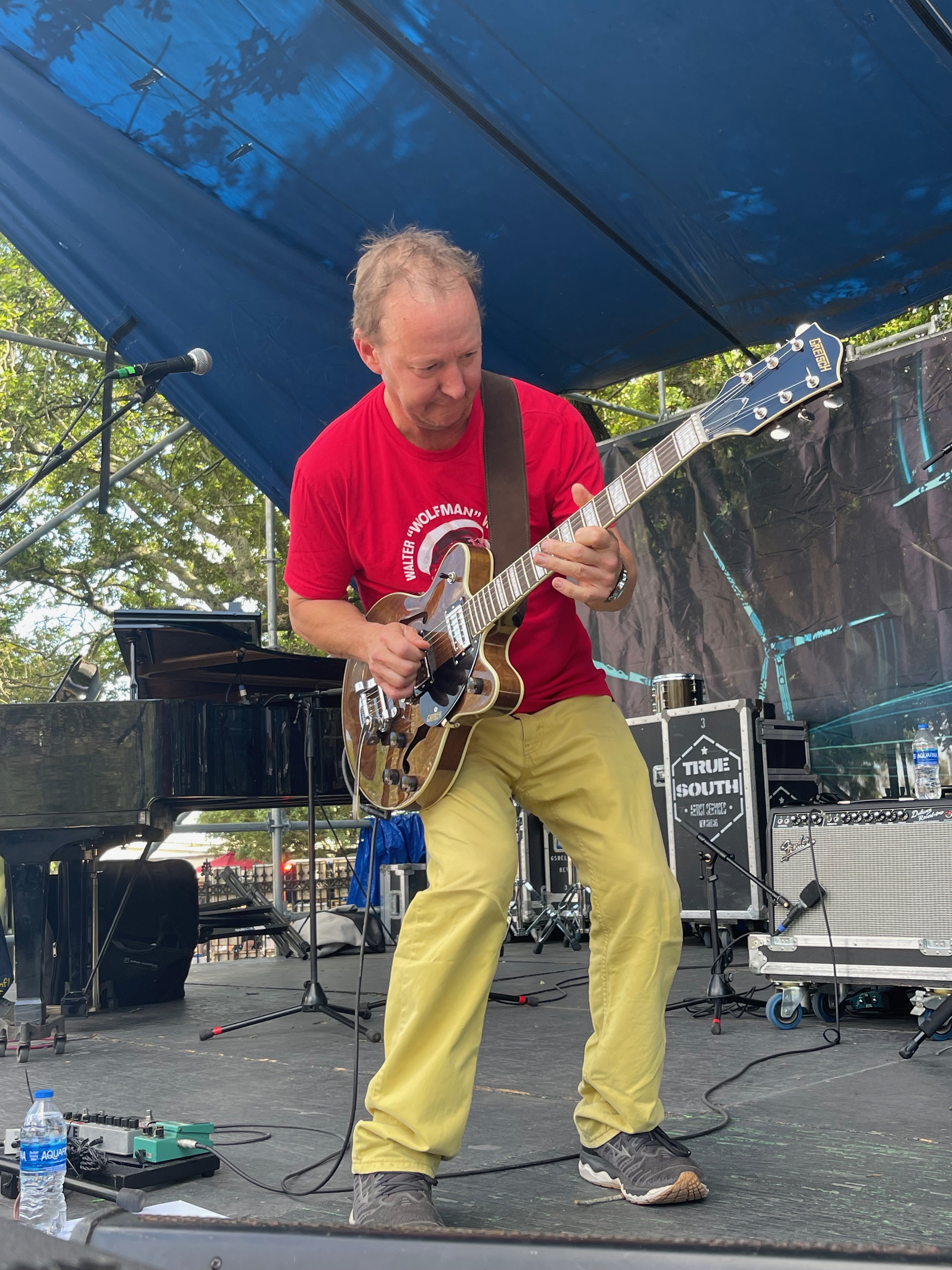
Alex McMurray grew up in Red Bank, New Jersey, and came to New Orleans in the late 1980s as a Tulane student. He never left. He has been writing and performing professionally in the city since 1989, and in that time he has become the songwriter other songwriters point to: ask around town who the best in town is, and McMurray's name is the one that comes back. Antigravity called him "the most talented songwriter in New Orleans," OffBeat called him "one of the best songwriters working today" and "the quintessential New Orleans singer-songwriter," and the critic John Swenson wrote that he "weaves myths that touch our collective soul."
His songs are sardonic, literate, and rooted in the specific textures of New Orleans life — the bars, the characters, the crooked and the broken — and he has carried them through a dozen bands and projects. Royal Fingerbowl ran from 1995 to 2001; the Tin Men, a sousaphone-washboard-guitar trio with Matt Perrine and Washboard Chaz Leary, have played Jazz Fest and the city's clubs since 2003; 007 plays Jamaican rock-steady and reggae; the Valparaiso Men's Chorus, twenty-plus voices strong, grew out of six months McMurray spent singing sea shanties as "Cap'n Sandy" at Tokyo DisneySea in 2001. His Tuesday-night solo residency at Buffa's — a continuation of the Wednesday gig he held at the Circle Bar from 1999 — is one of the essential recurring shows in the city. His records run from How to Be a Cannonball (2010, Big Easy Album of the Year) and I Will Never Be Alone In This Land (2012) through Lucky One and Road Songs (2020) to The Recent Future (2022), and he has won OffBeat's Best Country/Folk/Singer-Songwriter Artist award twice, in 2020 and 2023. He appeared as himself in HBO's Treme and co-organized the Jazz Fest fringe festival ChazFest.
Start with: The Recent Future (2022); How to Be a Cannonball (2010); I Will Never Be Alone In This Land (2012); Lucky One (2020).
Watch: Alex McMurray, solo performance for the "Letter From The Porch" series — https://www.youtube.com/watch?v=DQ_eUDc-bM4 · The Tin Men, "Blackbird Special" at d.b.a., December 2010 — https://www.youtube.com/watch?v=rI7jBwK1hYI
A first listening path
If you want five records, in order:
- Fats Domino, "Blueberry Hill" (1956) — the melody that made the world hum New Orleans.
- Professor Longhair, "Tipitina" (1953) — the sound of the city in a single piano riff.
- Allen Toussaint, "Southern Nights" (1975) — the groove as composition.
- Susan Cowsill, Lighthouse (2010) — the personal record.
- Jon Cleary, "Frenchmen Street Blues" — the new standard.
Then go hear it live — a Wednesday happy hour at Carrollton Station, a Frenchmen Street set, a living-room show. That's where this music still lives.
Who's not here (yet)
Six names a singer/songwriter guide ought to include are missing, and the reason is stated plainly: Smiley Lewis, Lloyd Price, Guitar Slim, Shirley Goodman, Jessie Hill, and Benny Spellman have no nolamusic.net pages yet, so they are not entries here. Lewis was the voice of Dave Bartholomew's songs — "I Hear You Knocking" and "One Night" were his records first. Price wrote "Lawdy Miss Clawdy" and "Stagger Lee." Guitar Slim wrote "The Things That I Used to Do." Goodman, with Leonard Lee as Shirley & Lee, wrote "Let the Good Times Roll." Hill wrote "Ooh Poo Pah Doo." Spellman sang Toussaint's "Fortune Teller." The guide grows as the pages do — and when those writers get pages, they get entries.
More in this series
Introduction to New Orleans Music — six guides to the sounds that built the city. Piano · Trumpet · Trombone · Clarinet · Drums · Singer/Songwriters. See all six guides →