New Orleans drumming starts on the street. The parade beat — bass drum and snare drum in conversation, the roll-off that starts the band moving — is the oldest rhythm in the city, and every drummer in this guide learned it, whether they ended up in a recording studio, a jazz club, or a funk band. The beat is the through-line: from the brass band to the studio to the festival stage.
The point of this guide is simple: hear the music, and if it grabs you, buy it. Every entry below leads with Listen & Buy links — the artist's nolamusic.net page, where the Listen bar carries Spotify and Apple Music, plus Louisiana Music Factory, Euclid Records, and Amazon for buying. The prose is the invitation; the links are the purpose.
What follows is an introduction, not an encyclopedia: the sound itself, the line of players who made it, and the living musicians still carrying it. Every artist below has a page on nolamusic.net, linked at the top of each entry.
What it sounds like
Six things to listen for. Once you hear them, you'll recognize the style anywhere.
The backbeat. Earl Palmer's straight-eight backbeat on Fats Domino's "The Fat Man" (1949) — the snare on two and four, played straight instead of swung — became the rhythmic foundation of rock and roll. Hear it in "The Fat Man," recorded December 10, 1949, at Cosimo Matassa's J&M Studio.
The second-line feel. Smokey Johnson's "It Ain't My Fault" (1964) puts the street parade on the drum kit: the bass drum and snare answering each other, the hi-hat hissing over the top, the beat loose and exact at once. Hear it in "It Ain't My Fault."
The funk pocket. Zigaboo Modeliste's "Cissy Strut" (1969) is built on space and placement rather than density — the groove sits back, the hi-hat does half the talking, and nothing is wasted. Hear it in "Cissy Strut."
The modern jazz voice. Johnny Vidacovich and Astral Project took the New Orleans groove into forward-leaning improvisation — the beat swings hard and still sounds unmistakably like the city. Hear it in Astral Project, or in Vidacovich's drumming on Professor Longhair's Crawfish Fiesta.
The big-band engine. Herlin Riley spent years in Wynton Marsalis's band, where the drums have to swing a big band with precision and joy at once. Hear it in Blood on the Fields (1997).
The living street beat. Shannon Powell still demonstrates the parade roll-off and press roll — the rudiments every New Orleans drummer learns — in Preservation Hall's free lessons. Hear it in his "Roll Offs and Press Rolls" lesson.
The founders
Earl Palmer (1924–2008)
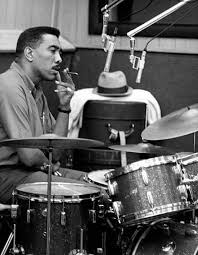
Earl Cyril Palmer was born October 25, 1924, in New Orleans, and grew up performing in his family's vaudeville act before becoming a jazz drummer. By the late 1940s he was the drummer of choice at Cosimo Matassa's J&M Studio on Rampart Street, where virtually every important early rhythm-and-blues and rock-and-roll record was made. On Fats Domino's "The Fat Man," recorded December 10, 1949, Palmer played what many musicologists consider the first rock-and-roll drum beat — a straight-eight feel drawn from the New Orleans second-line tradition that replaced the swing pattern of jazz.
The sessions piled up: Little Richard's "Tutti Frutti," Lloyd Price's "Lawdy Miss Clawdy," Smiley Lewis's "I Hear You Knocking," and hundreds more. Palmer left New Orleans for Hollywood in 1957 and became one of the Wrecking Crew, the Los Angeles session players behind a decade of hits, and spent more than thirty years playing on film and television soundtracks. In 2000 he became one of the first session musicians inducted into the Rock and Roll Hall of Fame. His own line on the beat he invented: "I didn't think I was inventing anything. I was just playing what the music needed."
Start with: Fats Domino, "The Fat Man" (1949); Little Richard, "Tutti Frutti" (1955); Lloyd Price, "Lawdy Miss Clawdy" (1952); Drumsville (Liberty, 1961), his album as a leader.
Watch: "The Fat Man" (Fats Domino, 1949) — https://www.youtube.com/watch?v=aIz1cPfTRW4 · "The Fat Man" (version 1, December 10, 1949) — https://www.youtube.com/watch?v=nftncTMcZ8U
Smokey Johnson (1936–2015)

Joseph "Smokey" Johnson Jr. was born November 14, 1936, in New Orleans and raised in Tremé. He started on trombone and switched to drums at twelve, and by 1957 he had joined Dave Bartholomew's band, taking over the drum chair from his mentor Earl Palmer, who had moved to Los Angeles. Johnson became Fats Domino's drummer through the 1950s and '60s and one of the city's most sought-after session players, recording with Professor Longhair, Allen Toussaint, and dozens of others.
In 1964 he became the house drummer for Wardell Quezergue's Nola Records, and that year he released the two-part single "It Ain't My Fault," written with Quezergue around a drum cadence Johnson had carried for years — one of the first tunes to bring second-line syncopation into pop music, and now a Mardi Gras and brass-band standard. He also drove Earl King's "Trick Bag," with its hissing hi-hat and syncopated second-line beat. A stroke in 1993 ended his playing career; he died October 6, 2015.
Start with: "It Ain't My Fault" (1964); It Ain't My Fault (compilation of his Nola Records sides); Earl King, "Trick Bag."
Watch: "It Ain't My Fault" — https://www.youtube.com/watch?v=SlBuc863hU0 · "Smokey Johnson says hi to Earl Palmer" (video interview) — https://www.youtube.com/watch?v=81J-AnvYQe8
The funk line
Zigaboo Modeliste (b. 1948)

Joseph "Zigaboo" Modeliste was born in 1948 in the 13th Ward of New Orleans, the eldest of six, raised in part by his grandmother Lula Blouin, who bought him his first three-piece drum kit. He absorbed the street parade tradition early — the syncopated second-line rhythms that became the foundation of everything he built — and as a teenager joined the Hawketts, fronted by Art Neville, playing clubs like the Nite Cap and the Dew Drop Inn.
In 1965 the Meters formed, with Modeliste on drums alongside Art Neville, Leo Nocentelli, and George Porter Jr. They became Allen Toussaint's house band at Sansu Enterprises, backing Lee Dorsey, Dr. John, Labelle, and Robert Palmer, and their own records — "Cissy Strut," "Look-Ka Py Py," "Hey Pocky A-Way" — were stripped-down, minimalist, and hypnotic, built on Modeliste's gift for creating rhythmic tension through space and placement rather than density. "Cissy Strut" was inducted into the Grammy Hall of Fame in 2011, and the Meters received the Grammy Lifetime Achievement Award in 2018. After the band broke up, Modeliste toured with Keith Richards and Ron Wood in the New Barbarians, and Eminem sampled his drumming for the 2014 chart-topper "Berzerk."
Start with: The Meters (1969); Look-Ka Py Py (1969); Struttin' (1970).
Watch: "Cissy Strut" — https://www.youtube.com/watch?v=oFYBRtV002s · "Cissy Strut" with Vulfpeck, live at the Fillmore (2017) — https://www.youtube.com/watch?v=-pif1fXxhNQ
Stanton Moore (b. 1972)
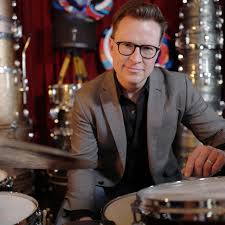
Stanton Moore was born July 9, 1972, in New Orleans, and came of age surrounded by the city's percussion tradition — second line, funk, jazz, and rhythm and blues all flowing into his playing. In 1994 he helped found Galactic, originally an eight-piece called Galactic Prophylactic, and the band's first album, Coolin' Off (1996), led to nearly two hundred gigs a year for ten straight years. Moore's drumming is the engine of the band: powerful, swinging, and endlessly creative inside the groove. His own line: "New Orleans drumming is about feel first. You can have all the technique in the world but if you don't have the feel, you don't have anything."
Beyond Galactic he has released nine records under his own name, the most recent With You In Mind: The Songs of Allen Toussaint, and played with Maceo Parker, Irma Thomas, Leo Nocentelli and George Porter Jr. of the Meters, Tom Morello, Donald Harrison Jr., Nicholas Payton, Trombone Shorty, and the Preservation Hall Jazz Band. He is also a teacher: his book Groove Alchemy was picked by Modern Drummer as one of the top 25 instructional drum books of all time, and he runs the Stanton Moore Drum Academy.
Start with: Galactic, Coolin' Off (1996); Galactic, The Other Side of Midnight: Live in New Orleans (2011); Stanton Moore, With You In Mind: The Songs of Allen Toussaint.
Watch: "You Don't Know" (Galactic live, New Year's Eve at Tipitina's) — https://www.youtube.com/watch?v=xh3u71Axo7U · "Musical Mileage" (studio lesson) — https://www.youtube.com/watch?v=MZdiBFAmI4M
The jazz line
Johnny Vidacovich (b. 1949)
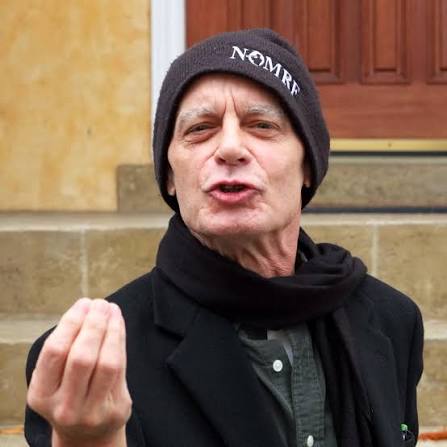
Johnny Vidacovich was born in New Orleans in 1949, started playing drums at ten, and was working professionally by the late 1960s, beginning with the Ronnie Dupont Quartet. He spent time with Al Hirt, then built a reputation as the drummer other musicians called when the music had to swing hard and feel unmistakably like New Orleans. His drumming is on two touchstones of the New Orleans canon: Professor Longhair's Crawfish Fiesta and James Booker's Classified.
In 1978 he co-founded Astral Project with Tony Dagradi, James Singleton, and Dave Torkanowsky — Steve Masakowski joined in 1987 — a group built on forward-leaning improvisation that became one of the city's landmark modern jazz bands. He has served on the faculties of Loyola University New Orleans and the University of New Orleans, and with Herlin Riley he co-wrote the method book New Orleans and Second Line Drumming. OffBeat honored him with a Lifetime Achievement Award in 2016, and he has been voted Best Drummer in the magazine's readers' poll a dozen times. According to WWOZ, he has played every New Orleans Jazz & Heritage Festival.
Start with: Professor Longhair, Crawfish Fiesta (1980); James Booker, Classified (1982); Nolatet, Somethin' to Relax With (2026).
Watch: "New Orleans Jazz" (Astral Project) — https://www.youtube.com/watch?v=XRIXp1yYGSQ · "It Ain't My Fault" beat, played solo — https://www.youtube.com/watch?v=oamdymN_M5s
Herlin Riley (b. 1957)

Herlin Riley was born February 15, 1957, in New Orleans, and started playing drums at three years old. He came up through the city's churches and brass bands, then spent three years with Ahmad Jamal, from 1984 to 1987, and joined Wynton Marsalis in 1988, playing and recording with the Jazz at Lincoln Center Orchestra for seventeen years. He helped develop the drum parts for Marsalis's Blood on the Fields, which won the Pulitzer Prize for Music. Wynton Marsalis has said that when he hears Riley play, he hears joy, spirituality, accuracy, and a musical ability that is encyclopedic in scope.
Riley now leads his own quintet and the New Orleans Groove Masters, with Jason Marsalis and Shannon Powell, and his Mack Avenue debut as a leader, New Direction, was followed by Perpetual Optimism. With Johnny Vidacovich he co-wrote the method book New Orleans and Second Line Drumming. He plays everything: cowbell, wood block, tambourine, the drum shell — and, on one night at the Bayou Bar in 2023, a waiter's water pitcher.
Start with: Wynton Marsalis, Blood on the Fields (1997); Wynton Marsalis Septet, Live at the Village Vanguard (1999); Herlin Riley, New Direction; Herlin Riley, Perpetual Optimism.
Watch: "Big Train" (Wynton Marsalis & the Lincoln Center Jazz Orchestra, live at Lincoln Center) — https://www.youtube.com/watch?v=AECZ-b0Lipc · "Cherokee" (Wynton Marsalis Septet, Bern, 1993) — https://www.youtube.com/watch?v=3blL4v-cY18
Shannon Powell (b. 1962)

Shannon Powell was born April 8, 1962, in New Orleans' Tremé neighborhood, and began playing drums at six, in his church, the First Garden Christ Church. The banjoist Danny Barker took him under his wing while he was still in grade school, and by fourteen he was playing professionally at Jazz Fest. He toured and recorded for six years with Harry Connick Jr., including the multi-platinum albums When Harry Met Sally... and We Are in Love, and has played with Wynton Marsalis, Diana Krall, Dr. John, and Earl King.
Back home, Powell leads his own quartet and plays regularly with the Preservation Hall Jazz Band, and he is known throughout the city as the King of Tremé. In 2010 he and Herlin Riley shared the Ascona Jazz Award from the Ascona Jazz Festival in Switzerland, and his interviews and performances feature heavily in the 2011 documentary Tradition Is a Temple, about Barker's legacy and the brass-band tradition.
Start with: Harry Connick Jr., When Harry Met Sally... (1989); Harry Connick Jr., We Are in Love (1990); the Preservation Hall Jazz Band's catalog, where Powell is a regular.
Watch: "Roll Offs and Press Rolls" (Preservation Hall Lessons) — https://www.youtube.com/watch?v=u8g8V_1WcpQ · "New Year's Eve 2015 at Preservation Hall" — https://www.youtube.com/watch?v=B8bwkfBI7Z8
Herman Lebeaux
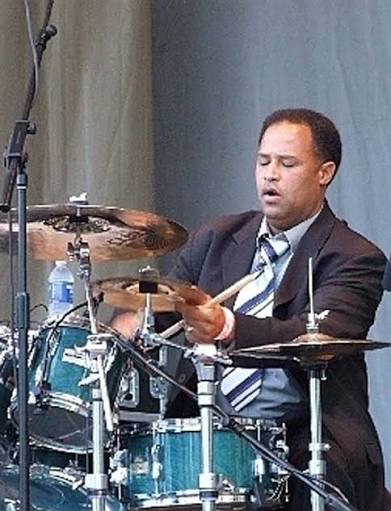
Herman Lebeaux is a New Orleans native drummer, composer, arranger, and educator who has held the drum chair with Allen Toussaint's band since 1996. He came up on the scene in the early 1980s, earned his bachelor's degree from Xavier University and a master's from the University of Massachusetts Amherst, where he studied under Max Roach, and has played with everyone from Fats Domino to Lenny Kravitz.
His credits run from Toussaint's recordings and the Keep It Funky documentary to playing the drummer in Ray Charles' band in the Oscar-winning film Ray. When he isn't touring, he teaches — at NOCCA, Xavier University, and the University of New Orleans — and leads the Herman LeBeaux Quartet. He is also Toussaint's son-in-law, and a regular at Snug Harbor with the NOLA Resistance Quintet.
Start with: The film Ray (2004) — Lebeaux plays the drummer in Ray Charles' band; Allen Toussaint's band recordings from his years in the chair; the NOLA Resistance Quintet, live at Snug Harbor.
Watch: There is no verified video of Lebeaux at the drums linked here — hear him through his page's Buy links, or watch for him in the film Ray (2004), where he plays the drummer in Ray Charles' band.
The working present
Jamison Ross (b. 1987)
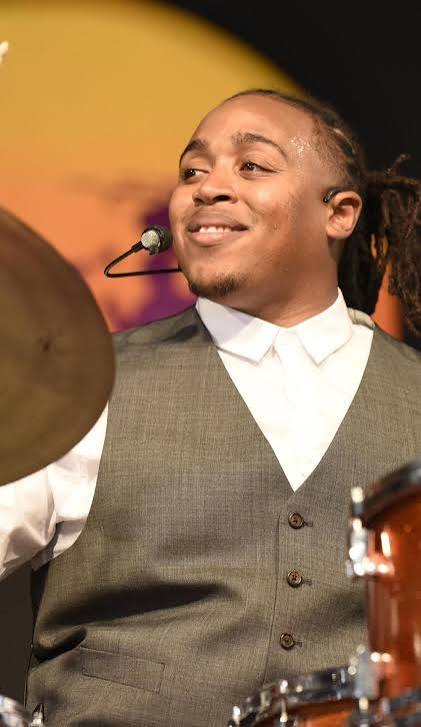
Jamison Ross was born November 12, 1987, in Jacksonville, Florida, and grew up singing and playing drums in his grandfather's church, leading the church band as Minister of Music by fifteen. He studied at the Douglas Anderson School of the Arts, earned a B.A. in jazz studies from Florida State University, then moved to New Orleans for a master's at the University of New Orleans — and stayed. In 2012 he won the Thelonious Monk International Jazz Competition for drums, earning a recording contract with Concord Jazz.
His 2015 self-titled Concord debut, recorded at Esplanade Studios with a guest appearance by Jon Batiste, was nominated for a Grammy for Best Jazz Vocal Album — a drummer's record that turned out to be largely a showcase for his singing. He followed it with All for One (2018), co-founded the independent label and management company Affective Music in 2019, producing Mykal Kilgore's Grammy-nominated single "Let Me Go," and released his third album, the soul-drenched JAMO, in 2022. He has toured as a drummer with Snarky Puppy and played on Jazzmeia Horn's Love and Liberation.
Start with: Jamison (2015); All for One (2018); JAMO (2022).
Watch: "Emotions" (lyric video) — https://www.youtube.com/watch?v=ShgBjMz-8Lk · "Don't Go To Strangers" — https://www.youtube.com/watch?v=rFe9i0kOusg
Jason Marsalis (b. 1977)

Jason Marsalis was born March 4, 1977, in New Orleans, the youngest of the four Marsalis brothers, and took his first drum lessons at six, from James Black. He made his first recording at fifteen and developed as a drummer through years with Marcus Roberts, his father's groups, and the Los Hombres Calientes Latin jazz ensemble he co-founded — then, in the late 2000s, surprised the jazz world by shifting his focus to the vibraphone.
The move stuck. His vibes quartet recordings show a compositional sensibility and a playful rhythmic intelligence entirely his own, and DownBeat has called him an irrepressible force since taking up the instrument. He still plays drums — alongside Herlin Riley and Shannon Powell he performs as part of the New Orleans Groove Masters — but the vibraphone is where his voice lives now.
Start with: In a World of Mallets (Basin Street); The 21st Century Trad Band (2014); the New Orleans Groove Masters, live, with Herlin Riley and Shannon Powell.
Watch: "The 21st Century Trad Band" (Jason Marsalis Vibes Quartet, live studio session) — https://www.youtube.com/watch?v=de5jBgoQD4U · "Jason Marsalis on drums with Marcus Roberts" — https://www.youtube.com/watch?v=gIkHAFWL4YA
Abe Thompson
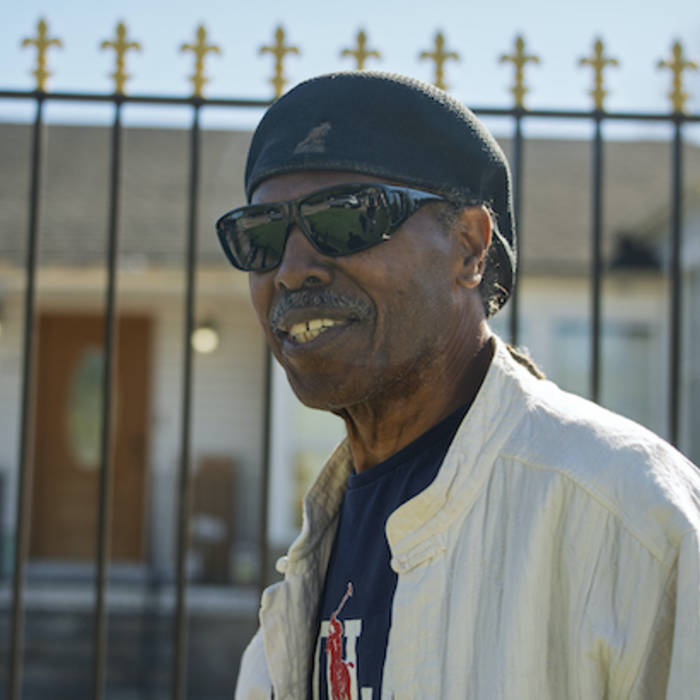
Abe Thompson grew up in New Orleans' Desire neighborhood and learned the drums by watching his brother Adrian play; he played his first gig at twelve. In his teens he was in bands alongside classmates at George Washington Carver High School, under band director Yvonne Busch, then went on to Southern University at New Orleans, where he studied under saxophonist Edward "Kidd" Jordan and earned his B.A. in music — part of the same SUNO generation as Carl LeBlanc and Julius Handy.
After school his career carried him about as far from New Orleans as a drummer can get: he spent four decades playing abroad in Taiwan. He has been back home since the 2010s, where — also known as Nbugu Kenyatta — he founded and leads the Doctors of Funk, a band built largely from fellow SUNO musicians, and fronts three other groups: ARRK-TU, the Kenyatta Trio, and the Kenyatta Funksters. In October 2026 he released After the Storm (is Life), six of his own songs, some written across a span of fifty years, in a gospel-rooted funk and soul setting, cut at Marigny Studios and produced by trombonist Evan Oberla.
Start with: After the Storm (is Life) (2026); Evan Oberla, Canal Street Revolution (2025), which carries Thompson's first-person accounts of the 1960s Canal Street sit-ins; the Doctors of Funk, live at the New Orleans Jazz Museum.
Watch: "The Richard Knox Trio" (Thompson on drums and vocals, Prime Example Jazz Pub) — https://www.youtube.com/watch?v=81sZQakDdbA
Simon Lott (b. 1982)
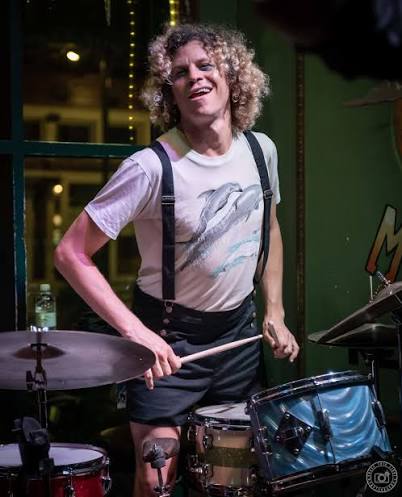
Simon Lott was born January 6, 1982, in Baton Rouge, and has been making music professionally since 1995, when he was thirteen. He recorded his first album of original music, the instrumental jazz record In The Parking Lott of Swing, at eighteen, then spent two years in New York after Hurricane Katrina, touring internationally, before returning south and settling in New Orleans. In 2010 he built his home recording studio, THE EARSE, where he cultivates the alter-egos Context Killer — live electronic dubs and looping on drum set and synths — and Diamond Kinkade, on piano and synthesizer.
He is the go-to drummer for players like Charlie Hunter and John Medeski, and his group credits include the Charlie Hunter Trio, Robert Walter's 20th Congress, and the Will Bernard Trio. Recent work includes the Compersion Quartet with Skerik, Brian Haas, and James Singleton — a set of New Orleans studio improvisations released by Royal Potato Records in February 2025 — and his ongoing Clouds ensemble with Jesse Morrow and Seth Finch.
Start with: In The Parking Lott of Swing (2000); Will Bernard Trio, Outdoor Living (2012); Robert Walter's 20th Congress, Spacesuit (2018); Skerik's Compersion Quartet (2025).
Watch: "Funky Miracle" (with Chris Buono, 2007) — https://www.youtube.com/watch?v=w32TB3K3eJE · "Anaïs St. John with Simon Lott" (live at Windsor Court, 2015) — https://www.youtube.com/watch?v=dzJ3uBNHxWg
A first listening path
If you want five records, in order:
- Fats Domino, "The Fat Man" (1949) — the backbeat is born.
- Smokey Johnson, "It Ain't My Fault" (1964) — the second line, on record.
- The Meters, "Cissy Strut" (1969) — the funk pocket.
- Wynton Marsalis, Blood on the Fields (1997) — the big-band engine.
- Jamison Ross, Jamison (2015) — the tradition, sung and drummed by one man.
Then go hear it live — a Preservation Hall night, a Frenchmen Street set, a second-line parade. That's where this music still lives.
Who's not here (yet)
Eight names a drums guide ought to include are missing, and the reason is stated plainly: Baby Dodds, Zutty Singleton, Paul Barbarin, Cie Frazier, Idris Muhammad, James Black, June Gardner, and Gerald French have no nolamusic.net pages yet, so they are not entries here. Baby Dodds is the biggest hole in the drum line as it stands. The guide grows as the pages do — and when those players get pages, they get entries.
More in this series
Introduction to New Orleans Music — six guides to the sounds that built the city. Piano · Trumpet · Trombone · Clarinet · Drums · Singer/Songwriters. See all six guides →