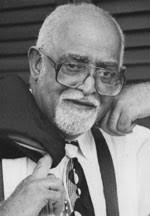
Wardell Joseph Quezergue (pronounced ka-ZAIR) was born on March 12, 1930, in the Seventh Ward of New Orleans into a musical family of Creole descent. He began playing trumpet and writing arrangements while still a student at Xavier Prep, where he directed the school band. He quit his junior year to enlist in the Army, serving during the Korean War — assigned to Tokyo to arrange music for military bands. He was actually en route to the airport, with fellow musicians, when an officer stopped the convoy and sent him back to base; the soldier who replaced him was killed in combat. Fifty years later, Quezergue completed A Creole Mass, an orchestral tribute to that man and all the others who died in that war.
Returning to New Orleans in the mid-1950s, Quezergue enrolled in a Seventh Ward music school for veterans and helped form the Royal Dukes of Rhythm, a dance band that became popular at school proms and club dates. He signed with Imperial Records, working as arranger for Fats Domino and recording with his own band Wardell and the Sultans. He co-founded Nola Records in the mid-1960s and took his work to Malaco Records in Mississippi, where some of his most celebrated sessions were recorded. In one marathon 1970 session at Malaco, he produced and recorded King Floyd's "Groove Me" and Jean Knight's "Mr. Big Stuff" back to back — two songs that would become cornerstones of New Orleans R&B.
His list of credits reads like a catalog of classic New Orleans music: the Dixie Cups' "Chapel of Love" and "Iko Iko"; Robert Parker's "Barefootin'"; Earl King's "Trick Bag"; Professor Longhair's "Big Chief"; Dorothy Moore's "Misty Blue." He co-wrote "It Ain't My Fault" with Smokey Johnson, a song later sampled by Mariah Carey and Silkk the Shocker. He produced and arranged Dr. John's Goin' Back to New Orleans, which won the Grammy for Best Traditional Blues Album in 1993. "Just drop him off on Planet Music," Allen Toussaint said, "and he was fine."
Quezergue lost his eyesight to diabetes in 2003 and then his lifetime collection of sheet music to Hurricane Katrina in 2005. Dr. John was at the forefront in organizing benefit concerts for him. He eventually returned to New Orleans and remained active as long as his health allowed, aided by his son Brian in transcribing his work. In 2009, some of New Orleans' finest musicians headlined a tribute to him at New York's Lincoln Center — a rare honor for an arranger. He was the recipient of an honorary doctorate in music from Loyola University. He passed on September 6, 2011, at 81.