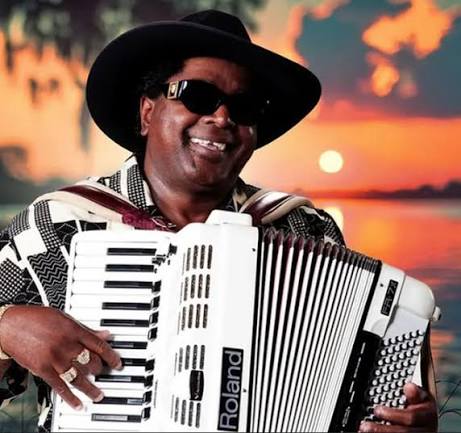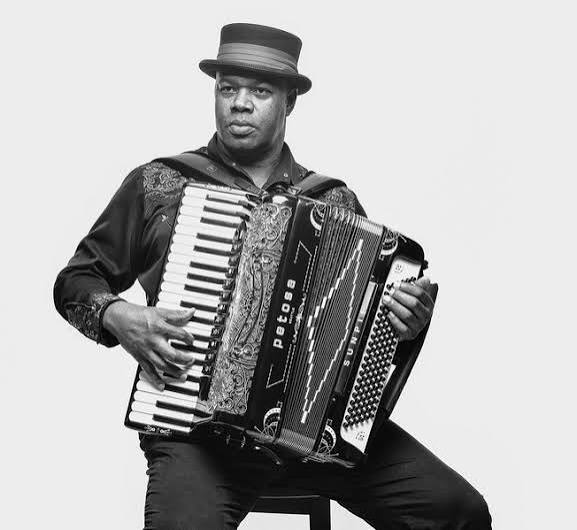
Bruce "Sunpie" Barnes was born May 18, 1963, in Benton, Arkansas, the tenth of eleven children born to sharecropper parents. He acquired his nickname from his Uncle Sunpie, a piano player who visited during holidays and played blues all night. Barnes went on to become a college football All-American and played in the NFL for the Kansas City Chiefs, later working as a high school biology teacher before beginning a career with the National Park Service that would span 30 years, including more than a decade at Louisiana's Barataria Preserve and, from 1999, the New Orleans Jazz National Historical Park, where he played music while educating visitors about the region's culture and traditions.
Barnes learned accordion from some of the best zydeco pioneers in Louisiana, including Fernest Arceneaux, John Delafose, and Clayton Sampy, and by 1991 had formed his band, Sunpie and The Louisiana Sunspots. A multi-instrumentalist skilled on accordion, harmonica, piano, trombone, rubboard, talking drum, and djembe, Barnes coined the term "Afro-Louisiana" music to describe the band's fusion of zydeco, blues, gospel, jazz, and African and Afro-Caribbean rhythms into what he calls a musical gumbo. The band has become a fixture at the New Orleans Jazz & Heritage Festival and the Louisiana Cajun-Zydeco Festival, released six critically acclaimed albums, and performed in more than 50 countries across Africa, Europe, Central America, and South America.
Barnes's music has been featured in 16 Hollywood film productions, including Déjà Vu and Jonah Hex, and on television shows including HBO's Treme. He narrated the 2006 documentary Reconstructing Creole, which won the 2007 Hollywood Documentary Award, and co-authored the 2015 book Talk That Music Talk: Passing On Brass Band Music In New Orleans "The Traditional Way," featuring more than 300 of his own photographs. Since 2010, Barnes has served as Big Chief of the Northside Skull and Bone Gang, one of the oldest existing Black Carnival groups in New Orleans, with traditions dating back to 1819, and remains an active member of the second-line parading organization Black Men of Labor Social Aid.