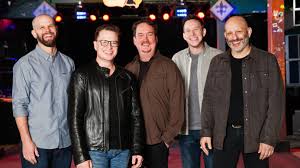
Rod Hodges and Joe Cabral met while playing together in Colorado in the late 1980s and moved to New Orleans separately in 1989, both drawn by friends in the Subdudes who told them they'd love the city. Hodges — a singer and guitarist raised partly in the San Francisco Bay Area who had rediscovered the conjunto music of his Mexican heritage through accordionist Flaco Jiménez — and Cabral — a Nebraska-born saxophonist and bajo sexto player who had discovered Chicago blues and New Orleans R&B in college — found that their musical instincts aligned perfectly. They started the Iguanas about a year after arriving, playing weekly gigs at the Rock 'N' Bowl.
The permanent lineup solidified when René Coman — a New Orleans native who had spent the late 1980s playing bass with Alex Chilton, Tav Falco's Panther Burns, and Willy DeVille — heard Hodges and Cabral at the Rock 'N' Bowl and liked what he found. "I liked the way Joe and Rod sang together," Coman has said. "And Joe has great rock 'n' roll tenor saxophone tone. Rod seems like a 2,000-year-old soul who's incapable of playing or singing a musical idea I disagree with." Coman joined in 1990. Memphis drummer Doug Garrison — who had also worked with Chilton and appeared on Charlie Rich's final recording — completed the lineup in 1993.
In 1993, Jimmy Buffett's Margaritaville Records released the Iguanas' self-titled debut — a pastiche of New Orleans funk, Latin music, and Mexican polka that announced them as something genuinely new. Crucially, the label came to them: "We never looked for a recording contract or sent out a demo," Hodges has said. The album's track "Para Donde Vas" appeared on the soundtrack of the 1996 John Travolta film Phenomenon. Their 1994 follow-up Nuevo Boogaloo hit No. 34 on the Billboard Heatseekers chart, and its track "Boom, Boom, Boom" was featured in Homicide: Life on the Street. Three albums for Margaritaville/MCA were followed by releases on a succession of other labels.
The Iguanas appear in Robert Mugge's 2006 documentary New Orleans Music in Exile, which captured the aftermath of Hurricane Katrina. They weathered that catastrophe — as they have weathered the collapse of the traditional music industry — without compromising either their sound or their connection to New Orleans. The current lineup of Hodges, Cabral, Coman, and Garrison has been essentially stable since the mid-1990s, a remarkable run that has produced a body of work spanning conjunto, R&B, garage rock, and soundtrack-ready Latin groove, all of it made in and for New Orleans.