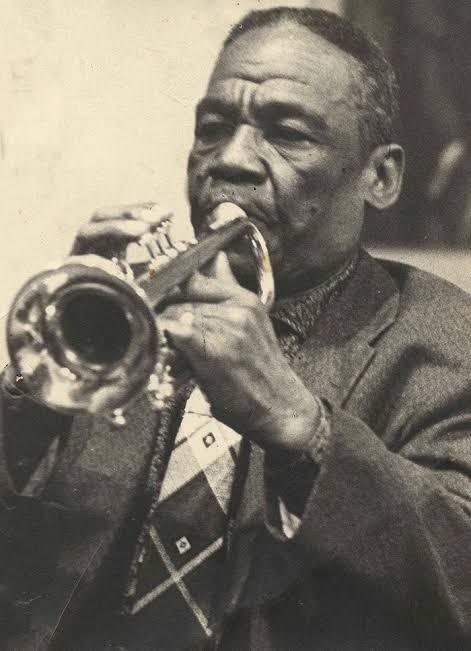
Ernest "Punch" Miller was born June 10, 1894, in Raceland, Louisiana. His nickname came early: since his twin sister was named Ernestine Judy, family and friends naturally dubbed the pair "Punch and Judy," after the popular puppet show of the era. Miller received early musical instruction on cornet, and later trombone and trumpet, studying under a number of musicians including the legendary Professor James Humphrey.
Miller was based in New Orleans from 1919 to 1927, leading the Crescent City Orchestra after taking it over from Jack Carey. In 1926 or 1927, he moved to Chicago, where he worked with an extensive roster of bands, including those of Jelly Roll Morton and Tiny Parham, and recorded with Frankie "Half-Pint" Jaxon, Albert Wynn, Jimmy Bertrand, Junie Cobb, and King Mutt and his Tennessee Thumpers. He also toured in vaudeville with Morton and bassist Fate Marable, though he later claimed in a 1971 documentary that Morton fired him over his heavy drinking — a struggle that would follow him for much of his life. In 1947, Miller appeared on the premiere episode of Rudi Blesh's radio program This Is Jazz, and for a time he barnstormed the country with carnivals and circuses, even performing alongside early rock & roll bands.
Miller returned to New Orleans in 1956 and struggled financially until the founding of Preservation Hall in 1961 gave him a genuine second act. He became one of the Hall's first stars, recording for Folkways in 1959 and the Icon label in 1960, and later for Atlantic and Imperial once the Hall was established. In 1963, he toured Japan alongside George Lewis. His last public performance came at the New Orleans Jazz & Heritage Festival, with Dizzy Gillespie in attendance. Miller was the subject of the 1971 television documentary 'Til the Butcher Cuts Him Down, filmed only months before his death in New Orleans on December 2, 1971.